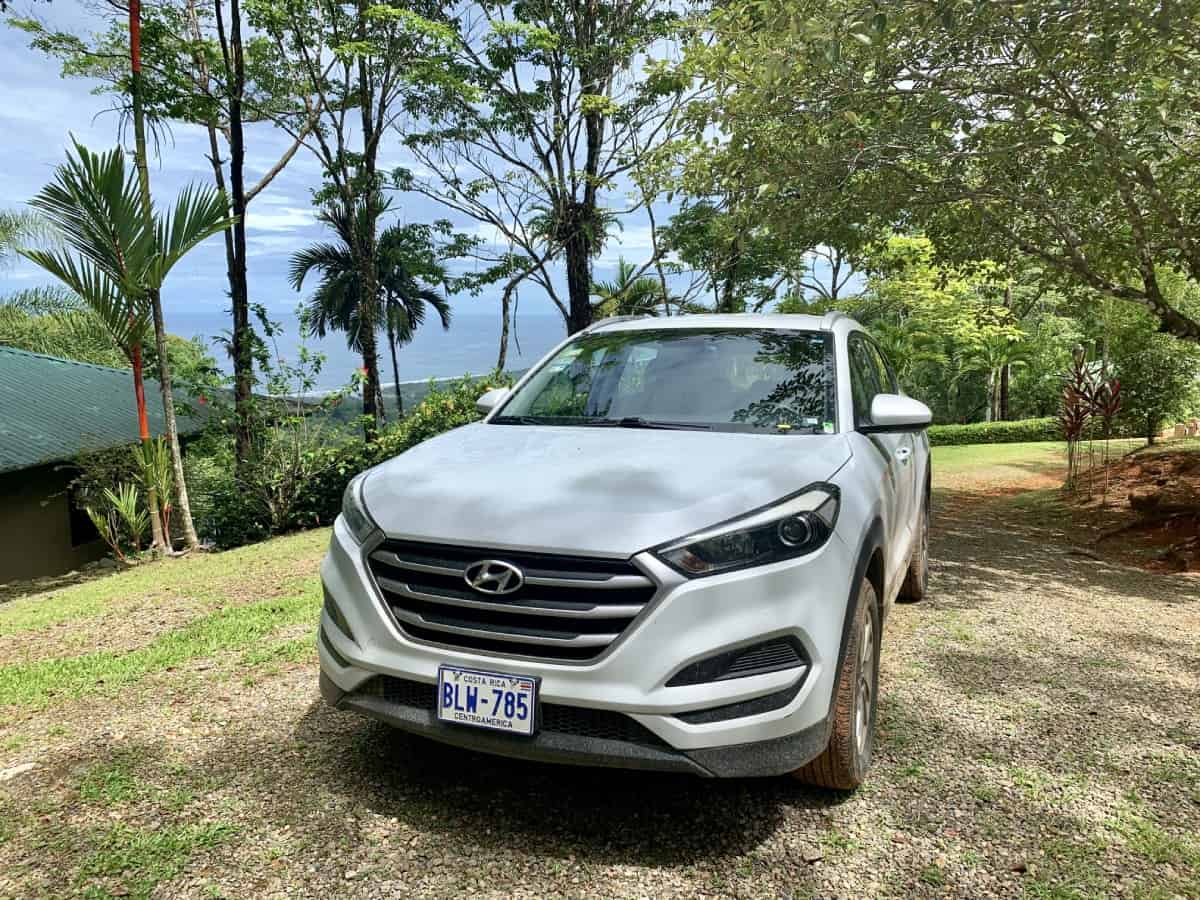
Renting a car in Costa Rica is one of those things that seems straightforward until you're standing at the rental counter and someone is explaining three different types of insurance you've never heard of. The rental itself is easy. The insurance conversation is where it gets complicated — and where most travelers overpay or, worse, end up underinsured.
We've rented cars in Costa Rica more times than we can count. Here's everything we've learned, starting with the part that matters most.
The Insurance Situation (Read This Carefully)
Costa Rica requires all rental cars to carry mandatory liability insurance. This is not optional — it's the law. Every rental company must include it, and you cannot decline it or replace it with your credit card. This mandatory coverage typically costs $15–25 per day on top of your rental rate.
Separately, there's collision damage coverage — the insurance that covers damage to the rental car itself. This is where you have options. Many credit cards (especially travel-focused ones like Chase Sapphire, Amex Platinum, or Capital One Venture) include rental car collision coverage as a cardholder benefit. If yours does, you can usually decline the rental company's collision coverage and save $15–30 per day.
The key thing to understand: mandatory liability insurance cannot be waived by anyone. Your credit card does not cover it. But collision coverage for the car itself — that's where your credit card can save you real money.
How to handle it
- Before your trip: Call your credit card company and confirm they cover rental car collision damage in Costa Rica specifically. Ask about the claim process and any exclusions (some cards exclude SUVs or unpaved roads — critical in Costa Rica).
- At the counter: Accept the mandatory liability insurance. If your credit card covers collision damage, decline the rental company's collision coverage. If your card doesn't cover it, accept it.
- Consider the deductible: Even with collision coverage (whether from the rental company or your credit card), there's typically a deductible of $750–1,500. Some rental companies offer a "zero deductible" upgrade. Whether that's worth it depends on your risk tolerance.
The $5/day trap
If you see rental cars online for $5 or $10 a day, know that there is no way you're avoiding the insurance costs at check-in. These rock-bottom rates exist because the companies make their money on the insurance add-ons, which will be inflated and essentially non-negotiable at the counter. What looked like a $70/week rental becomes $400+ once you're standing there with your luggage.
Why we recommend Alamo
After renting from many different companies in Costa Rica, Alamo is the one where we've consistently had the smoothest experiences and the least hidden fees. The price you book online is the price you pay — no aggressive upsell, no surprise charges at the counter. That alone makes them our go-to recommendation.
Do You Need a 4x4?
For Nosara, you don't strictly need a 4x4 — a lot of paving has been done recently, and a standard rental car can get you there. That said, a higher-clearance SUV is a really good idea. Many of the roads in and around Nosara are still unpaved, and the washboard gravel and occasional potholes are much more comfortable in something with a bit of clearance.
During green season (May through November), some sections can get muddy, and if you're planning to explore beyond Nosara — places like Playa Barrigona, Montezuma, or the back roads to Sámara — you'll be glad you have the extra capability.
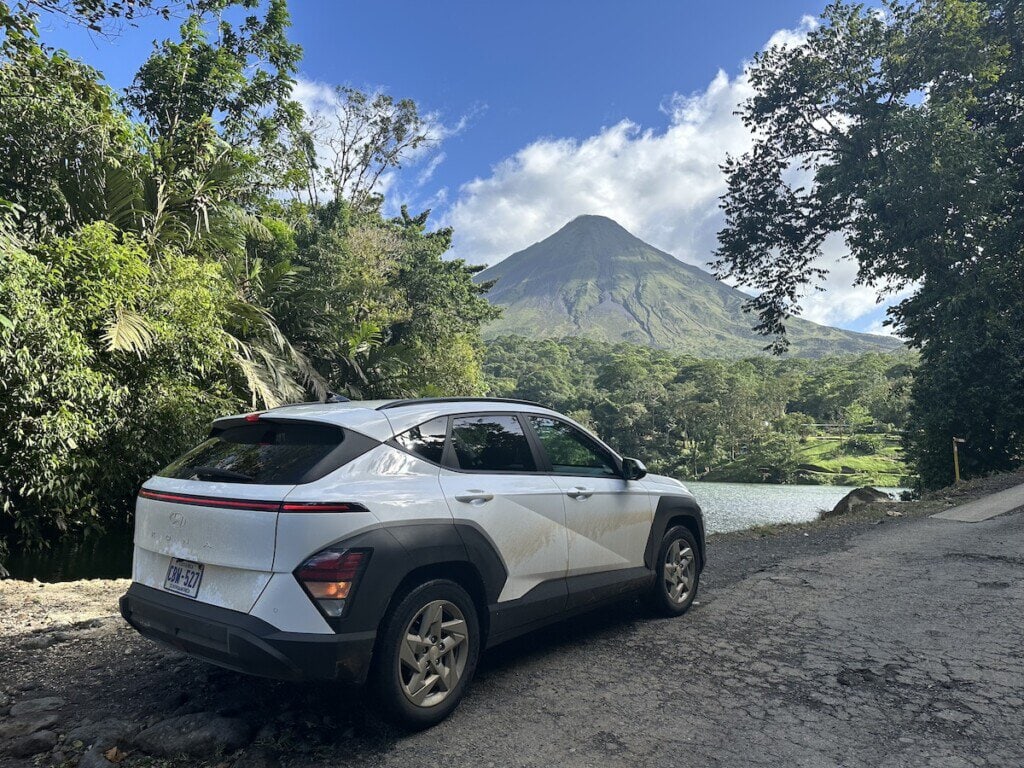
A compact SUV like a Hyundai Tucson, Suzuki Vitara, or Toyota RAV4 is the sweet spot. They're fuel-efficient enough for the highway sections, comfortable on the dirt roads, and small enough to park in tight spaces. You don't need a massive truck — just something with decent ground clearance.
Driving Tips for Costa Rica
Navigation
Use Waze. It's by far the best navigation app in Costa Rica — locals swear by it, it knows the current road conditions, and it'll route you around closures and traffic. Download offline maps as a backup before you go. Cell service is decent on main highways but can be spotty on remote peninsula roads.
Road conditions
Main highways between San José and Liberia are modern and well-maintained. Once you leave the highway for the Nicoya Peninsula, roads get progressively rougher. Expect unpaved sections, potholes, single-lane bridges, and the occasional cow in the road. It's all part of the adventure, but it does mean driving takes longer than the distance would suggest.
Fuel
Gas stations are plentiful on main routes but scarce in rural areas. Fill up before heading into the peninsula. Nosara has a gas station, but it's not uncommon for it to run out of fuel during peak demand. Don't let your tank drop below a quarter.
Safety
Don't leave valuables visible in the car — ever. Break-ins do happen at beach parking areas. Keep bags in the trunk or take them with you. Avoid driving at night on rural roads; the combination of potholes, unlit sections, and occasional pedestrians and animals makes it risky.
Your driver's license
Your valid home-country driver's license works for the duration of your tourist visa (up to 90 days). You do not need an international driving permit, though carrying one doesn't hurt.
What It Actually Costs
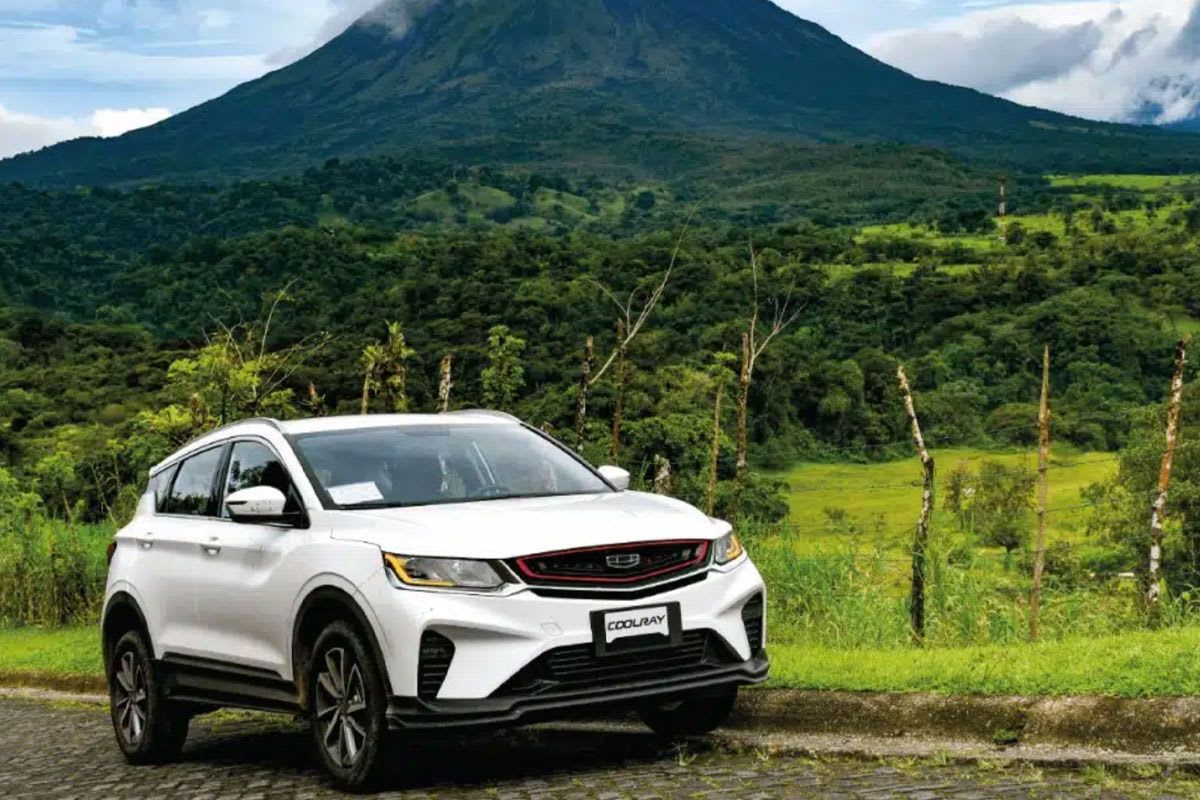
Budget roughly $40–80 per day for an SUV, including mandatory insurance. Add collision coverage if your credit card doesn't cover it, and you're looking at $60–110 per day all-in. Weekly rentals offer better per-day rates.
A few ways to save:
- Book through Alamo — the company where we've had the smoothest experiences and the least hidden fees. No games at the counter.
- Use your credit card's collision coverage to skip the rental company's collision insurance — that alone can save $15–30/day
- Book early, especially in high season (December through April)
- The Priceline trick: Book through Priceline, which allows free cancellation. Do this well in advance. Then about a week before your trip, check prices again — they've often dropped. If they have, cancel your existing reservation and rebook at the lower rate. We do this every time.
Our Recommendation
Rent a compact SUV from Alamo. Accept the mandatory liability insurance. Use your credit card's collision coverage if it covers Costa Rica. Download Waze. Fill up before heading to the peninsula. And enjoy the drive — getting to Nosara is half the adventure.
Need help planning your arrival? We're happy to share our current favorite routes and tips. Check availability on our booking page, or reach out on WhatsApp — we'll help you get here.